
 8 min read
AI Engineer Salary in 2026, and Why Your Budget Is Built on the Wrong Number

Two respected sources published an AI pay premium this year. PwC says 62 per cent. Ravio says 12 per cent.
Both are measuring 2026. Both are comparing AI engineers against equivalent software engineers. Only one of them is measuring money that actually reached a bank account.
That gap matters, because an AI engineer salary set from advertised pay is a different number from one set from payroll, and the distance between them is wide enough to break a headcount plan.
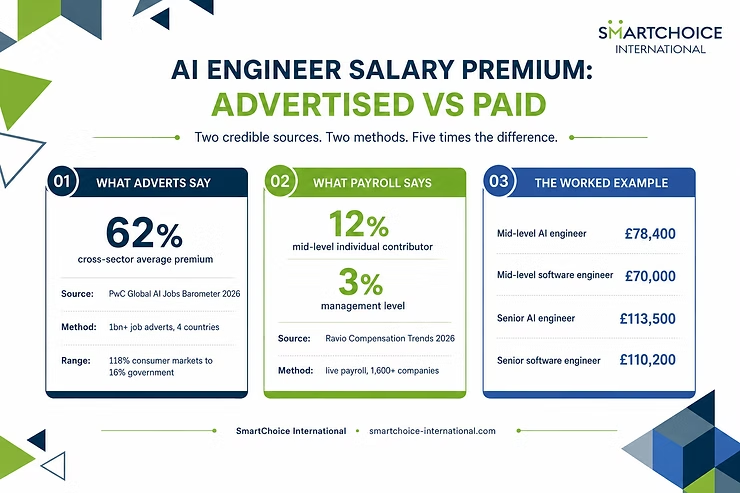
PwC's 2026 Global AI Jobs Barometer, published on 15 June 2026, reports that workers with AI skills command a 62 per cent wage premium, up from 57 per cent the year before. It is drawn from more than a billion job adverts, and it has been quoted in almost every hiring article since.
Ravio, which reads live data from the human resources systems of more than 1,600 companies, puts the AI and machine learning premium in European technology at 12 per cent on the individual contributor track and 3 per cent at management level.
Same year, same roles, and one number is five times the other.
The 62 per cent figure is real, but it is not measuring what you think
PwC states its method openly: the premium is the difference between salaries offered for roles requiring AI skills and salaries offered for comparable roles that do not. It measures what employers put in job adverts.
Two details fall away when the headline travels. The wage premium analysis covers four countries only, Canada, Singapore, the UK and the US, because that is where the data allowed it. And the premium varies enormously by sector: 118 per cent in consumer markets, 84 per cent in technology, media and telecoms, 67 per cent in professional services, 53 per cent in financial services and 16 per cent in government.
So there is no single 62 per cent. There is a cross-sector average across four countries, built from adverts.
Ravio measures something else entirely. It reads actual paid compensation through live integrations with more than 75 payroll and human resources systems, across 618,000 datapoints. It is not asking what employers say they will pay. It is reading what they paid.
Both are credible. They answer different questions. Only one of them answers the question you ask when you set a budget.
What employers actually pay for an AI engineer salary
Ravio's own comparison is the clearest illustration published this year.
A mid-level AI engineer sits at £78,400 against £70,000 for a mid-level software engineer. That is a 12 per cent premium, and it is real money on a team of ten.
Move up one level and it nearly vanishes. A senior AI engineer sits at £113,500 against £110,200 for a senior software engineer. Three per cent.
The premium shrinks as seniority rises
This is the reverse of what most hiring plans assume. Teams budget their largest premium for their most senior AI hire, because that is where scarcity feels most acute.
The payroll data says the premium is widest in the middle of the track and close to nothing at the top. At senior level you are not paying for AI. You are paying for seniority, and the market priced that a long time ago.
The UK contract market behaves similarly. ITJobsWatch, for the six months to 13 August 2026, puts the median machine learning contract rate at £575 a day, against £525 for DevOps and £500 for data engineering. A premium, plainly, but 10 to 15 per cent rather than 62.
There is a subtlety underneath that worth catching. Over the same period the median permanent salary for a UK software engineer fell 12.5 per cent, from £80,000 to £70,000. When the baseline drops, every premium calculated against it looks larger. Some of the widening gap between AI and non-AI pay is not AI rising. It is everything else falling. The same pattern shows up across infrastructure roles, which we set out in our UK DevOps and cloud engineer salary benchmark.
One more figure from the same source. Permanent roles advertised with AI show median pay of £72,500, growing 3.57 per cent year on year. Over the same window, architecture grew 6.25 per cent, analytics 12.5 per cent and security-cleared roles 12 per cent. AI salaries are rising more slowly than several specialisms nobody is calling a bubble.
Three markets, three different answers
We recruit across the UK, Central and Eastern Europe and the Gulf, and the published data shows the premium behaving differently in each.
In Poland and Bulgaria, AI is not the best-paid discipline
This one surprises people. Poland's No Fluff Jobs report, covering full-year 2025 data and published in January 2026, puts senior AI and machine learning business-to-business rates at PLN 23,000 to 28,560 a month.
Architecture pays more, at PLN 26,880 to 33,600. Security pays more, at PLN 25,200 to 30,240. Data and business intelligence pays more. So does DevOps.
Bulgaria repeats the pattern. DEV.BG's analysis of advertised salaries to May 2026 ranks machine learning, AI and big data seventh by top advertised salary, behind back-end development, data science, infrastructure, Java, DevOps and enterprise resource planning.
There is one genuine exception, and it is at the bottom of the ladder. Minimum advertised business-to-business rates for junior AI roles in Poland rose 103.3 per cent year on year. The entry point moved sharply while the senior end stayed flat, which tells you the shortage is in people who have done it once, not in people who have done it for a decade.
If you are building through nearshore delivery in Poland or Bulgaria, applying a large AI premium on top of local rates overpays against a market that does not charge one.
The Gulf premium is real, and it is concentrated
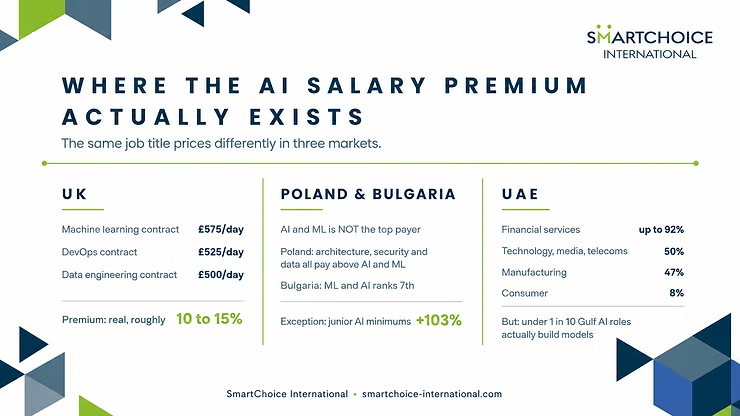
The UAE is the exception that proves the point. PwC's UAE analysis, reported in June 2026, finds AI wage premiums of up to 92 per cent in financial services, 50 per cent in technology, media and telecoms and 47 per cent in manufacturing, falling to 8 per cent in consumer businesses.
That is a serious premium. Read the sector spread before you apply it, though, because outside financial services and technology it thins fast.
There is a second thing to know before writing the job specification. GulfTalent classified 420 AI-connected vacancies across the UAE, Saudi Arabia and Qatar in the first half of 2026. Fewer than one in ten involved building or training models. About a quarter were sales roles for AI products. The remainder split between using AI within an existing job and rolling out tools somebody else built.
So most organisations paying an AI premium in the Gulf are not hiring researchers. They are hiring people who can put existing models to work. That distinction is worth settling before the budget is signed off, because a brief written for a research scientist will price like one even when a strong applied engineer would meet the requirement. Agree it internally before you brief an AI search in Dubai or the wider UAE.
Why advertised pay runs so far ahead of paid pay
Three things inflate the advertised number.
Job adverts are a negotiating position. They describe the top of a range most hires never reach. Poland's Just Join IT 2026 salary report found mid-level professionals earn up to 21 per cent less than the advertised range, while seniors often end up above what the advert promised.
The phrase "AI skills required" is also doing heavy lifting. A senior platform engineering role that happens to mention a machine learning pipeline is counted as an AI role. Its salary, driven by the seniority, is counted as an AI premium.
And disclosure is selective. Only 34 per cent of UK technology vacancies publish a salary at all, according to APSCo's second quarter 2026 analysis with CV-Library and Lightcast. The third that do are not a random sample. Employers advertise a number when the number is competitive.
How to set an AI engineer salary budget that holds
Four things we would do.
Benchmark against your own payroll before anything else. What you already pay a senior engineer is the most reliable anchor available. Apply a premium to that, not to a national average built from adverts.
Budget the premium in the middle of the track. The evidence points to roughly 12 per cent at mid-level and close to 3 per cent at senior. If your plan does the opposite, it was built on advertised data.
Separate the builders from the users. Fewer than one role in ten needs somebody who trains models. Write two job specifications and two budgets. The two candidate pools barely overlap, which is why we run data, AI and machine learning recruitment and software, cloud and DevOps recruitment as separate searches rather than one.
Price the churn, not just the hire. Mercer puts voluntary turnover in AI and machine learning roles at 18 per cent, the highest of any technology function, against 12 per cent for software engineering. A premium buying an 18-month tenure is a different investment from one buying five years. Harvey Nash's 2026 survey of more than 3,600 technologists is a useful counterweight here: 41 per cent said they would accept a lower salary for more home working. Cash is not the only lever, and it is rarely the cheapest.
One development worth watching. The EU Pay Transparency Directive's transposition deadline passed on 7 June 2026, and employers across the EU will increasingly have to publish pay ranges before interview. When ranges become mandatory, the distance between advertised and paid narrows by force. Expect the advertised premium to fall, not because AI talent became cheaper, but because the advertising became more honest.
What the numbers actually say
The AI engineer salary premium is real. It runs at roughly 12 per cent at mid-level in European technology, up to 92 per cent in Gulf financial services, and close to nothing at senior level across most European markets.
It is not 62 per cent, unless you happen to be competing in exactly the four-country advertised market that figure came from, and even then only in consumer businesses.
Budget from payroll, not from adverts. And if you are scoping an AI role and want a second opinion on what it should pay in your market before the budget is signed, tell us what you are hiring for.
Frequently asked questions
Payroll data from more than 1,600 companies puts the premium at about 12 per cent for mid-level individual contributors in European technology and about 3 per cent at management level. Advertised figures are much higher because they measure what employers offer rather than what they pay.
