
 6 min read
Staff Augmentation Explained: What It Is and When to Choose It Over Managed Services
Most technology leaders reach a point where the work in front of them outpaces the team they have. A delivery deadline moves forward, a specialist skill is missing, or a project needs more hands for a defined period. When this happens, two engagement models tend to come up: staff augmentation and managed services. They sound similar, yet they solve very different problems, and choosing the wrong one can cost you time, budget and control.
This guide explains what staff augmentation is, how it differs from a managed service, and how to decide which model fits the situation you are facing. By the end you will know exactly when to extend your own team and when to hand a function to an external provider.
What is staff augmentation
Staff augmentation is a flexible resourcing model where you bring external specialists into your existing team to fill a skills gap or add capacity. The professionals you take on work under your direction, follow your processes and report to your managers, exactly as a permanent employee would, but for an agreed period.
The defining feature of staff augmentation is control. You decide what the augmented staff work on, how they work and when their engagement ends. Your partner sources, vets and supplies the talent, while you keep ownership of the project, the priorities and the outcome. This is why the model is often described as an extension of your own workforce rather than a separate delivery team.
Staff augmentation is widely used in technology because skills demand changes quickly. A business might need a cloud engineer for a six month migration, a data specialist for a single build, or three additional developers to hit a release date. Hiring permanently for short term needs is slow and expensive. Augmentation gives you the right people at the right time, without the long commitment.
How the staff augmentation model works
The process is straightforward and tends to follow five stages:
You identify the gap. This might be a missing skill, extra capacity for a project, or cover for a vacancy.
Your partner proposes vetted candidates who match the technical and cultural requirements.
You interview and select, keeping full say over who joins your team.
The chosen specialists integrate into your team and begin work under your management.
You scale the engagement up or down as the project demands, then close it when the work is complete.
Because the specialists sit within your team, onboarding is quick and collaboration is direct. There is no handover of responsibility and no separate delivery layer to manage.
What is a managed service
A managed service is a different model entirely. Instead of adding people to your team, you hand an entire function or outcome to an external provider, known as a managed services provider. That provider takes responsibility for delivery, governance, quality and results. They use their own people, their own methods and their own management to meet an agreed standard.
With a managed service you are buying an outcome, not labour. A typical example is outsourcing the running of a help desk, the management of a cloud environment, or the ongoing maintenance of an application. You agree what good looks like through a service level agreement, and the provider is accountable for meeting it. Day to day, you are not directing the work. You are reviewing the results.
Staff augmentation vs managed services: the key differences
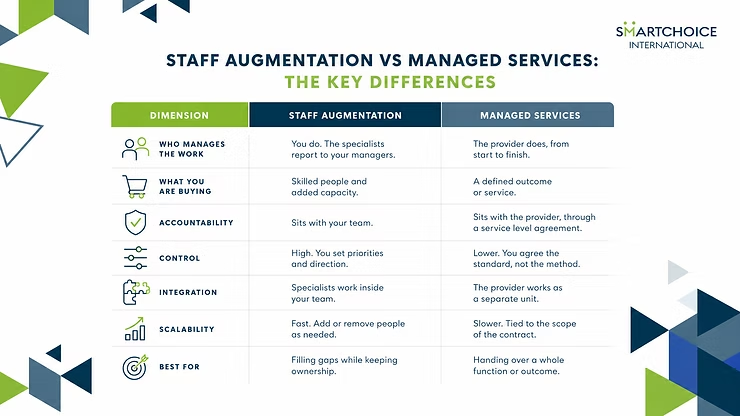
The simplest way to understand the two models is to look at who holds responsibility. With staff augmentation, you keep control and accountability. With a managed service, the provider takes them on. The table below sets out how the models compare across the dimensions that matter most.
Dimension | Staff augmentation | Managed services |
Who manages the work | You do. The specialists report to your managers. | The provider does, from start to finish. |
What you are buying | Skilled people and added capacity. | A defined outcome or service. |
Accountability | Sits with your team. | Sits with the provider, through a service level agreement. |
Control | High. You set priorities and direction. | Lower. You agree the standard, not the method. |
Integration | Specialists work inside your team. | The provider works as a separate unit. |
Scalability | Fast. Add or remove people as needed. | Slower. Tied to the scope of the contract. |
Best for | Filling gaps while keeping ownership. | Handing over a whole function or outcome. |
How staff augmentation differs from outsourcing and consulting
Staff augmentation, outsourcing and consulting are often confused, yet each plays a distinct role.
Outsourcing, in its fuller sense, means giving an external company responsibility for a complete process or function. A managed service is a form of outsourcing. Staff augmentation is not, because the work and the management stay with you.
Consulting is about advice and strategy. A consultant assesses a problem and recommends a course of action, shaping what should be done rather than carrying out the everyday delivery. Staff augmentation is the opposite. You already know what needs doing. You simply need skilled people to help you do it.
When to choose staff augmentation
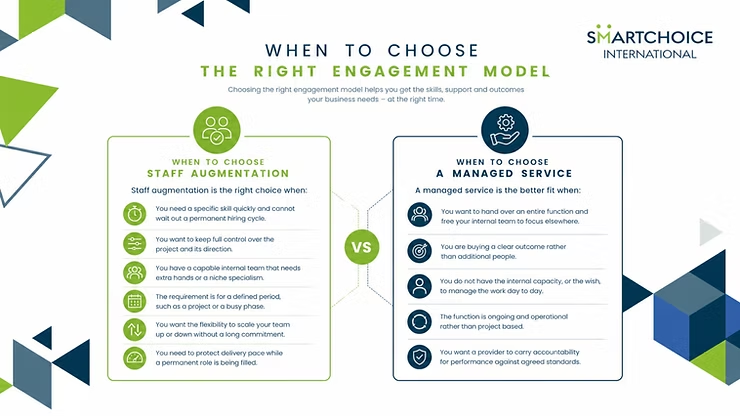
Staff augmentation is the right choice when:
You need a specific skill quickly and cannot wait out a permanent hiring cycle.
You want to keep full control over the project and its direction.
You have a capable internal team that needs extra hands or a niche specialism.
The requirement is for a defined period, such as a project or a busy phase.
You want the flexibility to scale your team up or down without a long commitment.
You need to protect delivery pace while a permanent role is being filled.
When to choose a managed service
A managed service is the better fit when:
You want to hand over an entire function and free your internal team to focus elsewhere.
You are buying a clear outcome rather than additional people.
You do not have the internal capacity, or the wish, to manage the work day to day.
The function is ongoing and operational rather than project based.
You want a provider to carry accountability for performance against agreed standards.
How to decide between the two models
If you are still weighing the options, three questions usually settle it.
First, do you want to keep control of the work, or hand it over? If control matters, augmentation fits. If you would rather delegate the whole thing, a managed service fits.
Second, are you buying people or an outcome? Capacity and skills point to augmentation. A guaranteed result points to a managed service.
Third, is the need temporary or permanent? Short term and project based needs suit augmentation. Long running operational functions suit a managed service.
Many businesses use both, augmenting their team for project work while running a managed service for stable operations. The two are not mutually exclusive, and a good partner will help you draw the line in the right place.
IT staff augmentation with SmartChoice
SmartChoice International provides IT staff augmentation services that give you fast access to vetted technology specialists across the UK, Poland, Bulgaria, Romania, the United States and the UAE. Whether you need a single contractor or a full agile delivery team, we supply onshore and nearshore talent that integrates directly into your team and works to your direction.
Our nearshore hubs across Eastern Europe give you skilled engineers aligned to your time zone and ways of working, with commercial models that can beat your current rate. Every specialist is checked through a proven vetting process, so you gain capability quickly without compromising on quality.
If your need is closer to a full function or outcome, our consultants can help you scope a managed engagement instead. The starting point is always the same: a conversation about what you are trying to achieve, not a list of job titles.
To talk through the right resourcing model for your next project, contact the SmartChoice team. We will respond with practical, sector specific advice and a clear recommendation.
Staff augmentation means bringing external specialists into your existing team for an agreed period. They follow your direction and processes, giving you extra skills or capacity without a permanent hire.