
 9 min read
Building a ServiceNow Team: In-house, Contractor, or Nearshore?
Every organisation running a serious ServiceNow programme arrives at the same resourcing question. The platform is in place, the first wave of modules has gone live, and the demand for new work is climbing faster than the existing team can absorb. Adoption is good. The business is asking for more workflows, more automation, more integrations. Your developers are stretched.
Now you have to decide how to grow capacity. Do you hire permanently into your team, bring in contractors to manage the peak, or stand up a nearshore function that scales without London or Munich salaries? There is no universally correct answer. The right model depends on the size and maturity of your ServiceNow estate, your budget cycle, the speed at which you need to deliver, the sensitivity of your data, and how willing your business is to take on long-term headcount.
What matters is making the choice deliberately rather than drifting into whichever model is easiest to justify in a given quarter. This guide is written for IT directors, programme managers, and CIOs who are sizing up their ServiceNow capacity and want a clear-headed view of the trade-offs.
The three resourcing models defined
Before getting into the comparison, it is worth being precise about what each model actually means in practice, because the language is often loose.
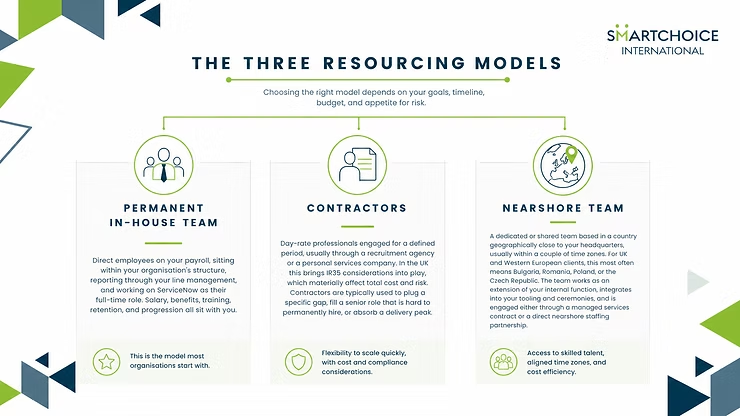
Permanent in-house team. Direct employees on your payroll, sitting within your organisation's structure, reporting through your line management, and working on ServiceNow as their full-time role. Salary, benefits, training, retention, and progression all sit with you. This is the model most organisations start with.
Contractors. Day-rate professionals engaged for a defined period, usually through a recruitment agency or a personal services company. In the UK this brings IR35 considerations into play, which materially affect total cost and risk. Contractors are typically used to plug a specific gap, fill a senior role that is hard to permanently hire, or absorb a delivery peak.
Nearshore team. A dedicated or shared team based in a country geographically close to your headquarters, usually within a couple of time zones. For UK and Western European clients, this most often means Bulgaria, Romania, Poland, or the Czech Republic. The team works as an extension of your internal function, integrates into your tooling and ceremonies, and is engaged either through a managed services contract or a direct nearshore staffing partnership.
The often-overlooked fourth option is offshore delivery, typically from India or Southeast Asia. We have written about the trade-offs of nearshore vs offshore separately. The short version is that for most ServiceNow work the time zone alignment, regulatory framework, and cultural proximity of nearshore Europe outweigh the per-hour saving of offshore.
Cost: what you actually pay across each model
Headline rate cards are misleading. The real cost of each model includes onboarding time, training, attrition risk, recruitment fees, project delays from understaffing, and the cost of firing decisions that did not work out. Some realistic 2026 figures for the UK market:
A permanent ServiceNow developer with three to five years of experience typically costs the employer between £75,000 and £95,000 per year in base salary, depending on location and module specialism. On top of that, employer National Insurance, pension contributions, holiday cover, training budget, equipment, and benefits add roughly thirty per cent. The fully loaded cost lands closer to £100,000 to £125,000 per year. A senior architect or platform manager in London sits well above that, often £130,000 to £170,000 fully loaded.
A UK contractor at the same experience level typically charges £550 to £750 per day inside IR35, which works out at roughly £125,000 to £175,000 per annum for a full year of continuous work. Outside IR35 rates are higher, but the inside-IR35 majority of public and large private sector engagements is what most buyers will see.
A nearshore developer of equivalent seniority working from Sofia, Bucharest, or Krakow typically costs the buying organisation between £45,000 and £70,000 per year on a fully loaded basis, including the partner's margin. That is a forty to sixty per cent saving against UK permanent total cost, and a fifty to seventy per cent saving against contractor day rates over a twelve month engagement.
These figures are deliberately broad. The real cost depends on module specialism (HRSD and ITSM developers cost less than ITOM or platform architects), location, scarcity of skill, and how the engagement is structured. The pattern is consistent: nearshore is materially cheaper than UK permanent and contractor models for the same calibre of engineer. The savings are not the only reason to choose nearshore, but they are real and they compound across a multi-year programme.
When permanent in-house wins
The in-house model is the right choice when continuity, institutional knowledge, and platform ownership matter more than speed or short-term cost. Specifically, it works best when:
You have a stable, predictable pipeline of ServiceNow work that justifies full-time roles indefinitely. If you can credibly forecast that you will need three platform developers for the next three years, hiring them is more cost-effective than running rolling contracts.
Your data, processes, or customers require deep proprietary knowledge that takes months to build and is expensive to lose. Public sector ServiceNow programmes, regulated financial services, and pharmaceutical implementations often fall into this category.
The roles being filled are leadership and architecture positions where retention and trust matter more than flexibility. A platform owner, technical architect, head of ServiceNow practice, or senior process consultant are very rarely good contractor or nearshore roles. They benefit from being permanent, internal, and senior.
Where the in-house model struggles is when demand is volatile, the talent pool is thin, or the cost of waiting for the right hire is greater than the cost of delivering through other means. In the UK ServiceNow market, time-to-hire for a mid-level developer is often three to four months. For a senior architect, six to nine months is common. If your roadmap cannot wait that long, in-house alone is not the answer.
When contractors win
Contractors are the right model when the need is specific, time-bound, and senior. Three situations stand out.
The first is bridging a hiring gap. A senior ServiceNow architect on a six-month contract while you recruit the permanent equivalent is a sensible use of contractor budget. You buy time without compromising the long-term plan.
The second is delivering a one-off project. A complex ITSM-to-ITOM migration, a major HRSD implementation, or a Now Platform upgrade is the kind of work that has a clear start and end. Hiring permanently for it would create a capacity overhang once the project finishes.
The third is filling a hard-to-source niche. Specialist skills in GRC, IRM, security operations, or workflow data fabric are scarce in the UK permanent market. Contractors who have built a career around these specialisms are often more available than equivalent permanent candidates.
Where contractors fail is when they are used as a long-term substitute for a proper team. Three years of rolling six-month extensions is more expensive than the equivalent permanent or nearshore option, creates knowledge concentration risk if the contractor leaves, and is increasingly scrutinised under IR35 for off-payroll working compliance. If you find yourself constantly extending the same contractors, the underlying demand is permanent and the resourcing model should be too.
When nearshore wins
Nearshore is the right model when you need to scale quickly, manage cost across a multi-year programme, or build delivery capacity that adapts to changing demand without the friction of permanent hiring and firing cycles. It is particularly effective for ServiceNow work because the platform's modular nature and standard development patterns transfer well across borders, and because the talent pools in Bulgaria, Romania, and Poland are now deep enough to provide genuinely senior engineers.
The nearshore model works well when:
You have a sustained programme of work that exceeds what your existing internal team can deliver, and you do not want to commit to fully equivalent permanent UK headcount. This is the most common situation. The internal team retains ownership of architecture, governance, and stakeholder management, while the nearshore team handles development, configuration, integration, and ongoing platform support.
You are scaling fast and cannot wait for UK recruitment cycles. A nearshore partner with a pre-vetted talent pipeline can typically have engineers onboarded within four to six weeks, which is roughly half the time of UK permanent hiring at the same experience level.
You operate in multiple European markets and want delivery capacity that works across time zones rather than against them. Bulgaria and Romania sit one to two hours ahead of UK time, which means a six to seven hour daily overlap with London teams and almost full overlap with German, Dutch, and French teams.
You want predictable, controllable cost across a multi-year platform investment. Nearshore engagements are typically priced on a monthly or quarterly basis with clear scaling mechanisms. Compared to permanent hiring, which is hard to reverse, and contractors, which can drift in cost, nearshore offers the cleanest commercial structure for finance leaders to plan against.
Where the nearshore model struggles is when the work being delivered is so deeply embedded in proprietary internal context that no external team can do it well, or when the partner you choose is poor. The first is rare. The second is common, which is why partner selection matters more than partner type.
The hybrid model: what most mature ServiceNow teams actually look like
After working with dozens of ServiceNow programmes, the pattern we see again and again is that mature organisations do not pick one of the three models. They run a hybrid.
A typical setup at a mid-sized UK enterprise looks like this. The platform owner, technical architect, and one or two senior process consultants are permanent UK employees. They own the strategy, the governance, the stakeholder relationships, and the long-term health of the platform. A specialist contractor or two are brought in for specific projects with a clear scope, such as a Now Assist rollout or a CMDB rebuild. A nearshore team of four to ten developers sits beneath this layer, handling the bulk of configuration, customisation, integration, testing, and platform support. The nearshore team scales up and down by quarter as the roadmap demands.
This structure works because each model is doing what it is best at. Permanent staff hold institutional knowledge and direction. Contractors handle complex, time-bound expertise. Nearshore handles volume, predictability, and cost-efficient delivery. The total cost is lower than an all-permanent team, the speed is higher than an all-contractor approach, and the risk is more diversified than relying on any single source of talent.
The mistake most organisations make is starting with one model and only realising too late that they should have built a hybrid from the beginning.
Common mistakes to avoid
A few patterns recur often enough to call out.
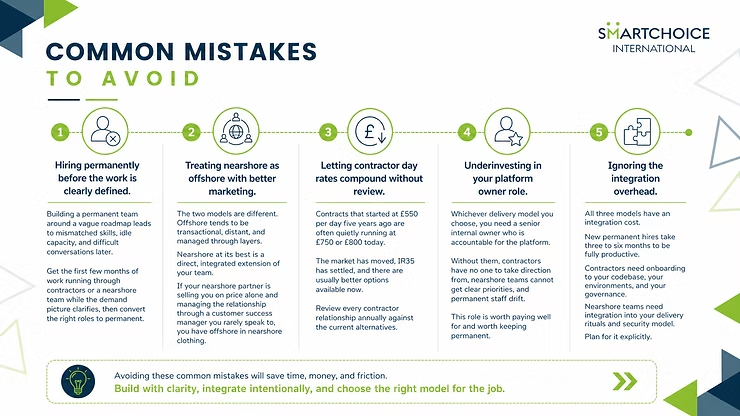
Hiring permanently before the work is clearly defined. Building a permanent team around a vague roadmap leads to mismatched skills, idle capacity, and difficult conversations later. Get the first few months of work running through contractors or a nearshore team while the demand picture clarifies, then convert the right roles to permanent.
Treating nearshore as offshore with better marketing. The two models are different. Offshore tends to be transactional, distant, and managed through layers. Nearshore at its best is a direct, integrated extension of your team. If your nearshore partner is selling you on price alone and managing the relationship through a customer success manager you rarely speak to, you have offshore in nearshore clothing.
Letting contractor day rates compound without review. Contracts that started at £550 per day five years ago are often quietly running at £750 or £800 today. The market has moved, IR35 has settled, and there are usually better options available now. Review every contractor relationship annually against the current alternatives.
Underinvesting in your platform owner role. Whichever delivery model you choose, you need a senior internal owner who is accountable for the platform. Without them, contractors have no one to take direction from, nearshore teams cannot get clear priorities, and permanent staff drift. This role is worth paying well for and worth keeping permanent.
Ignoring the integration overhead. All three models have an integration cost. New permanent hires take three to six months to be fully productive. Contractors need onboarding to your codebase, your environments, and your governance. Nearshore teams need integration into your delivery rituals and security model. Plan for it explicitly.
How SmartChoice International approaches this
Our work with UK and Western European clients sits across all three models. We place permanent ServiceNow professionals into roles where retention and proprietary knowledge matter, including platform architects, ITSM specialists, ITOM specialists, process consultants, and product owners. We provide contractor capacity for time-bound projects and senior gap roles. And we build nearshore ServiceNow teams from our talent network across Bulgaria and Romania, where there is genuine senior engineering capacity at fifty to sixty per cent of UK fully loaded cost.
Most of our active engagements end up combining at least two of these. A client who starts with a contractor placement for a senior platform manager often comes back six months later for a nearshore team to handle the development backlog the new manager has identified. A client building an entirely new ServiceNow practice often runs all three models in parallel from the start.
What we focus on is the suitability of the model to the work, not selling whichever option carries the highest margin. The conversation that adds the most value is usually the one about your roadmap, your existing capacity, your budget cycle, and what you need to deliver in the next six to twelve months. The model follows from that.
Where to go from here
If you are sizing up your ServiceNow capacity for the next financial year, the practical next step is to map your roadmap demand against your existing team's capacity, identify the gap by role and seniority, and decide for each gap whether the work is permanent, project, or volume. That mapping makes the resourcing model self-evident in most cases.
We are happy to run that exercise with you as part of an initial conversation. You can browse the specific roles we place on our ServiceNow expertise hub, or get in touch through our contact page to discuss your programme directly.
For more on the underlying nearshore model, our complete strategy guide on IT recruitment in Bulgaria covers the talent landscape, cost structure, and operating model in detail.