
 7 min read
UAE Labour Law for Tech Employers: What You Must Get Right Before You Hire

Get a technology hire wrong in the UAE and the fine now starts at AED 100,000. Since the penalties were raised in 2024, putting someone on the wrong permit, or running a role as fictitious employment, can cost an employer between AED 100,000 and 1 million for every worker involved, up to a ceiling of AED 10 million.
That is the sharp end of a bigger shift. UAE labour law changed more between 2022 and 2026 than in the four decades before it, and most of the parts that catch tech employers out are the ones they assume work like their home market. We place engineers across the Emirates, so we see where contracts, probation and exits go wrong. Here is what you need to get right before you open a technology role.
What UAE labour law actually is now
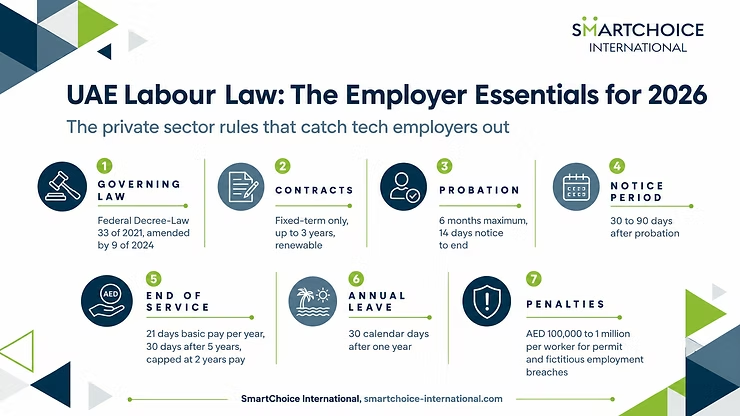
The rulebook is Federal Decree-Law No. 33 of 2021 on the Regulation of Labour Relations, in force since 2 February 2022 and tightened again by Federal Decree-Law No. 9 of 2024. It replaced a law that had stood since 1980, and the Ministry of Human Resources and Emiratisation, MoHRE, enforces it across the private sector.
Two changes matter most if you hire technology people. Every contract is now fixed-term, and the old unlimited contract is gone. And the law formally recognises the ways tech teams actually work, including remote, flexible, part-time and temporary models, each with proportional entitlements. That gives you room to build a team in more than one shape, as long as the paperwork matches the reality.
The contract rules that trip up tech employers
A UAE employment contract now runs for a fixed term of up to three years and can be renewed. If you still have anyone on a legacy unlimited contract, it should already have been converted, since the deadline for that passed at the end of 2025.
Probation is where speed-focused tech hiring often slips.
Probation and notice periods under UAE labour law
Probation can last no longer than six months. During it, you must give an employee 14 days' written notice to end the contract. If the employee wants to leave in that window to join another UAE employer, they owe you one month's notice, and the incoming employer may have to cover your recruitment cost. Once probation ends, notice runs between 30 and 90 days, with 30 days the common minimum and longer periods for longer service. Either side can pay in lieu of notice rather than work it. For project work that cannot wait on a 90 day exit, this is one reason many teams add vetted contractors through an IT staffing model rather than permanent hires.
End of service, leave and pay: what you are on the hook for
The running cost of an employee in the UAE is not just salary. Three obligations catch employers out at budget time.
How end of service gratuity is calculated
End of service gratuity is due to anyone with at least one year of continuous service. You set aside 21 days of basic pay for each of the first five years, then 30 days of basic pay for each year after that, capped at two years' total pay. It is worked out on basic salary, not the full package, so allowances do not count. An engineer on AED 15,000 basic who leaves after four years is owed about 84 days of basic pay, roughly AED 42,000. One change worth knowing: the gratuity is now the same whether the person resigns or you let them go, which was not the case under the old law.
Annual leave is 30 calendar days a year once someone passes a year of service, and it accrues from day one. Sick leave, after probation, runs up to 90 days a year, the first 15 on full pay, the next 30 on half pay and the rest unpaid. Maternity leave is 60 days, 45 on full pay and 15 on half, with 5 days of parental leave for both parents. On top of pay, you must run salaries through the Wage Protection System and make sure staff are enrolled in the unemployment insurance scheme, ILOE.
Free zones change the rules: DIFC and ADGM
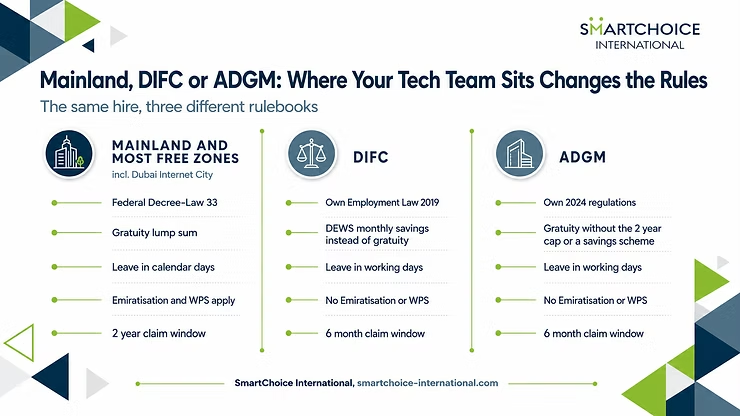
Here is the part most tech employers miss. Where your team legally sits decides which rulebook applies, and it is not always the federal one.
Mainland companies and most free zones, including technology hubs such as Dubai Internet City, follow Federal Decree-Law No. 33. The two financial free zones do not. The DIFC runs its own DIFC Employment Law No. 2 of 2019, and the ADGM runs its own 2024 regulations, both built on English common law.
The differences are not cosmetic. In the DIFC, the end of service lump sum is replaced by a funded monthly savings scheme, DEWS, where you pay in 5.83 per cent of basic salary for the first five years and 8.33 per cent after that, so the cost moves from a payout at exit to a monthly contribution. Annual leave in the DIFC and ADGM is counted in working days, not calendar days, so a payroll set to 30 calendar days will overpay or underpay. Emiratisation quotas and the Wage Protection System do not apply inside these two zones. And a departing employee has only six months to bring a claim, against two years on the mainland. If you move someone between zones, treat it as a fresh hire, because the legal basis resets.
For a technology employer choosing where to base a team, this is a real cost and risk decision, not a box-ticking one. It is worth a view before you sign the first offer, something our UAE team works through with clients as part of building the hire.
Termination and the cost of getting it wrong
The real risk in UAE labour law is rarely the salary. It is the exit.
You can only end a contract for a valid reason. Dismiss someone without one and a labour court can award up to three months of full wages for arbitrary dismissal, on top of gratuity, notice pay and any unused leave. You can dismiss immediately, without notice or gratuity, only for the narrow list of serious misconduct in Article 44, and even then only after a documented internal investigation. A verbal sacking with no paper trail is how a straightforward exit becomes an arbitrary dismissal claim. The law also protects employees who raise legitimate complaints from retaliatory dismissal, and it now gives them two years, not one, to bring a claim.
This is why process matters as much as the decision. The employers who get into trouble are usually the ones who moved fast and wrote nothing down.
Emiratisation sits on top of all this
If you employ 50 or more people on the mainland, Emiratisation targets apply, and technology is one of the sectors in scope. The target rises by 2 per cent of skilled roles each year, and missing it costs AED 108,000 a year for every unfilled Emirati position. Faking compliance is far worse, with fines from AED 100,000 to 1 million. From 1 January 2026 there is also a minimum salary of AED 6,000 a month for the Emirati hires who count towards your target. It is a planning item, not an afterthought, and it sits alongside everything above.
How to hire tech staff in the UAE without getting caught out
A few habits keep you clear of the fines and the claims.
Get the contract and permit right on day one, matched to the real shape of the role, whether that is a full-time engineer, a remote specialist or a fixed project. Decide early where the team sits, mainland or free zone, because that choice sets your end of service cost, your leave maths and your Emiratisation exposure. Budget for gratuity, leave and the Wage Protection System as running costs, not surprises. And keep records for anything touching performance or exit.
For roles you cannot fill fast enough locally, or where you would rather not take on the entity and compliance load at all, weigh permanent hiring against contract and nearshore options. Many UAE firms now build part of their engineering capacity through nearshore teams in Europe, which sidesteps some of this while keeping hours that overlap the Gulf day. When you do hire directly, working with an IT recruitment agency in Dubai and the UAE that knows the market keeps both the shortlist and the contract on solid ground, and it pairs well with getting your roles and budgets right for the year.
This is a general overview, not legal advice. Confirm the detail with a UAE employment lawyer or MoHRE before acting on any specific case.
Frequently asked questions
Private sector employment on the UAE mainland is governed by Federal Decree-Law No. 33 of 2021, enforced by MoHRE. The DIFC and ADGM financial free zones have their own separate employment laws, so the rules depend on where the employee is based.
If you are building a technology team in the UAE and want the contract, the zone and the shortlist to line up, talk to our team and we will share what we see across the market.