
 6 min read
IT Salaries in Dubai: What Tech Roles Really Pay in 2026
The average pay rise across the UAE for 2026 is 1.6 per cent. If you build your technology budgets around that figure, you will lose your shortlist before the first interview.
That average hides a split that matters to anyone hiring engineers this year. Most roles are seeing small, careful adjustments. A smaller group, the AI, cloud, data and security people every company suddenly wants, are pulling away fast. IT salaries in Dubai are no longer one market. They are two, and the gap between them widens every quarter.
We place these people, so we see the offers that close and the ones that get ignored. Here is what tech roles actually pay in Dubai in 2026, in AED, where the money is moving, and how to set a number that wins the hire without overpaying.
Why IT salaries in Dubai are splitting in two
Cooper Fitch expects the average UAE salary to rise just 1.6 per cent in 2026, with most adjustments landing between zero and five per cent. Only a small share of employers are budgeting six to nine per cent, and they are saving it for the roles they cannot afford to lose.
Technology sits squarely in that second group. Recruiters and salary trackers agree that pay is climbing fastest for AI and data analytics, cyber security and cloud, the same skills at the centre of nearly every digital project in the region. Around half of UAE firms say they plan to lift salary ranges this year, and the increases are concentrated where talent is scarce.
There is a second pressure most private employers underrate. Government and sovereign technology programmes, names such as G42, ADNOC Digital and Smart Dubai, routinely pay 15 to 30 per cent above private sector benchmarks for the same role. When a well funded, state backed team wants the same cloud architect you want, last year's range will not get you a reply.
This is why benchmarking to an out of date figure hurts. The average is calm. The roles you need are not.
What tech roles pay in Dubai in 2026
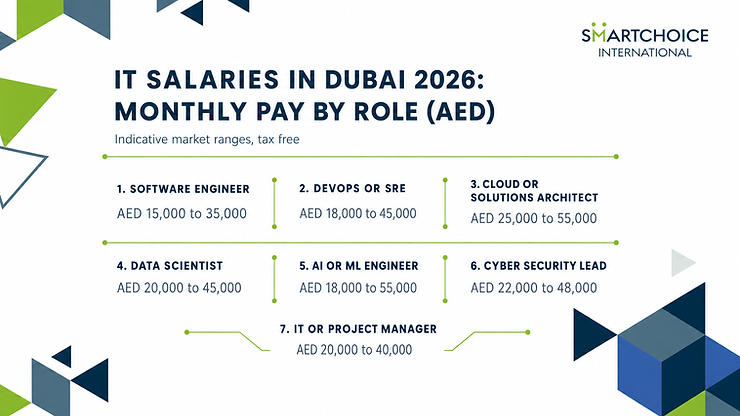
The ranges below bring together public 2026 salary data from UAE market sources and live job adverts. They are monthly figures in AED, and because there is no personal income tax in the UAE, the headline number sits close to take home pay. Treat them as a market starting point, then calibrate against real offers.
Role | Typical monthly pay in 2026 (AED) |
Software developer or engineer | 15,000 to 35,000, juniors from about 8,000 |
Full stack developer | 16,000 to 32,000 |
DevOps or site reliability engineer | 18,000 to 45,000 |
Cloud engineer | 15,000 to 27,000 |
Cloud or solutions architect | 25,000 to 55,000 |
Data engineer | 16,000 to 36,000 |
Data scientist | 20,000 to 45,000 |
AI or machine learning engineer | 18,000 to 55,000 |
Cyber security analyst or engineer | 14,000 to 32,000 |
Cyber security lead or architect | 22,000 to 48,000 |
Chief information security officer | 35,000 to 75,000 and above |
IT or project manager | 20,000 to 40,000 |
SAP or ERP consultant | 20,000 to 36,000 |
Software developer and engineer salaries in Dubai
A mid level software developer salary in Dubai now sits roughly between AED 15,000 and 25,000 a month, with senior and lead engineers reaching 30,000 to 35,000 where the stack is in demand. Juniors start lower, from around 8,000. The spread is wide because a front end developer building routine screens and a senior engineer who can own a platform are no longer priced anywhere near each other. We recruit across software, cloud and DevOps roles every week, and the gap by real capability is the biggest change from two years ago.
DevOps, cloud and infrastructure salaries
DevOps and site reliability engineers carry a premium because migration and platform work has not slowed. Expect 18,000 to 45,000 a month depending on seniority, with a cloud engineer salary in Dubai starting nearer 15,000 and a cloud or solutions architect reaching 55,000 at the top. Pay for classic on-premises infrastructure roles, by contrast, is flat, since the routine work keeps moving to the cloud.
Data and AI salaries
This is where the sharpest rises are. A data scientist salary in Dubai runs from about 20,000 to 45,000 a month, data engineers from 16,000 to 36,000, and an AI or machine learning engineer can reach 55,000 or more at the senior end. Demand here has outrun supply, which is why we tell clients building data, AI and machine learning teams to plan early rather than expect a quick hire.
Cyber security salaries in Dubai
Tighter regulation and a steady rise in attacks have pushed a cyber security salary in Dubai up at every level. Analysts and engineers sit between 14,000 and 32,000 a month, leads and architects between 22,000 and 48,000, and a chief information security officer well beyond that. Strong security engineers rarely stay on the market, so most firms bring in help to source cyber security specialists rather than wait for an inbound CV.
How to benchmark IT salaries in Dubai
The single mistake we see most often is benchmarking IT salaries in Dubai against last year's internal band. Pay for scarce skills has moved since then, and candidates know it. Use current market ranges, check them against live offers for the exact stack and seniority, and revisit the number the day you open the role, not the day you approved the headcount.
The highest paying IT jobs in Dubai right now
If you are tracking the highest paying IT jobs in Dubai, the pattern is clear. AI and machine learning leads, principal data scientists, cloud and solutions architects, and senior security leadership sit at the top, and the strongest packages go to people who pair a scarce skill with real UAE market experience. Enterprise platform specialists earn a niche premium too, ServiceNow and SAP in particular, because the pool that can configure and extend these platforms has not kept pace with how fast UAE enterprises are adopting them.
What actually decides the number, beyond the job title
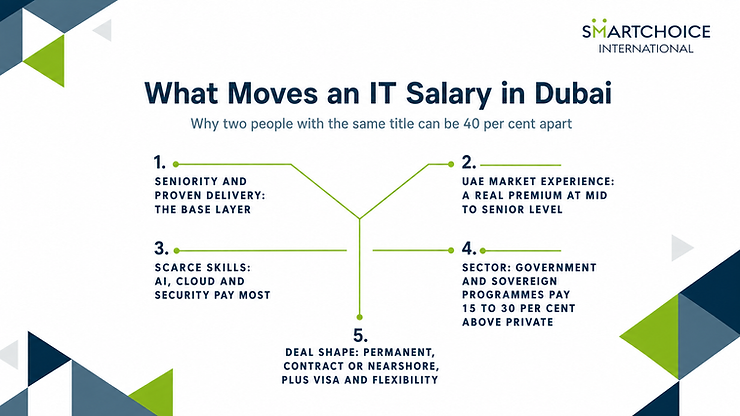
Two candidates with the same title can be 40 per cent apart on pay, and the reasons are consistent.
Seniority and proven delivery come first. UAE market experience is next, and it carries a real premium at mid to senior level because it cuts onboarding risk. Scarce skills, AI, cloud and security above all, add another layer. Sector matters, with government and sovereign programmes paying above private benchmarks. And the shape of the deal counts. A contractor day rate looks very different from a permanent salary, and senior candidates now weigh a Dubai package against remote offers from Europe, so visa certainty and flexibility carry weight the base figure never shows. It is a point we set out in our look at why Dubai keeps drawing tech talent.
How to set pay that wins the hire without overpaying
Three moves keep you competitive without inflating every band.
Benchmark to the current market for the exact role and stack, not to last year and not to a national average. For scarce skills, budget nearer the top of the range and start the search early, because the best people are rarely available for long, something we set out in our view on which roles to prioritise in 2026.
Decide the hiring model role by role. Permanent pay makes sense for the core of your product. For work that cannot wait, contract and IT staffing let you add vetted capacity in weeks, and it is worth weighing permanent against contract and nearshore before you commit. For AI, data and DevOps skills that are scarce and costly locally, many UAE firms now build part of the team through nearshore hubs in Europe, at a predictable cost and with hours that still overlap the Gulf day.
Make the offer about more than the base. Tax free pay, visa support, flexibility and genuinely interesting work often close a candidate that another 2,000 dirhams a month would not.
If you want a second view on where your ranges sit, our UAE team benchmarks tech roles against live offers as an IT recruitment agency in Dubai and the UAE built specifically for technology hiring.
Frequently asked questions
Most IT professionals in Dubai earn between AED 15,000 and 35,000 a month in 2026, though scarce specialists in AI, cloud and security earn well above that. Because there is no personal income tax in the UAE, the headline figure sits close to take home pay.
If you are setting technology pay for the year and want to know what an offer needs to look like to land, talk to our team and we will share what we are seeing across the Dubai and UAE market.